With the signing of Ranger Suárez, the Boston Red Sox have created what may be the best rotation in the American League, along with the best pitching depth in possibly not just the American League but the entire Major Leagues. With a potential starting five of Garrett Crochet, Suárez, Sonny Gray, Brayan Bello, and Johan Oviedo, the Red Sox have turned their attention towards run prevention.
Add to it Kyle Harrison and a healthy Kutter Crawford and Patrick Sandoval, and the Red Sox have a deep rotation to open the season, even deeper than what they had in 2025. That’s without taking into consideration the fact that Boston will potentially have an entire rotation of pitching depth in Worcester made up of players on the 40-man roster. Both Connelly Early and Payton Tolle were key additions to the pitching staff down the stretch, but there’s a good chance they open the season in Triple-A.
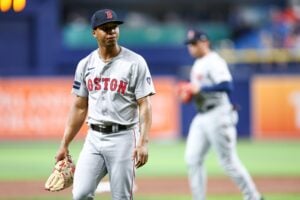
Where the Pitching Depth Stands for the Red Sox Heading Into 2026
The Dual Aces
Last offseason, the Red Sox acquired Crochet in a trade with the Chicago White Sox with the desire to make the left-hander their team’s ace. Well, in his first full season with Boston, did he ever deliver. The Pig lived up to expectations as he made 32 starts and went 18-5 for Boston. He pitched to a 2.59 ERA. In the process, he shattered his career high for innings by pitching 205 1/3 innings and struck out 255 batters.
Garrett Crochet, 100mph on his 117th Pitch. ?
11th K. pic.twitter.com/5oONH5o557
— Rob Friedman (@PitchingNinja) October 1, 2025
Crochet showed why the Red Sox went after him. Even when he struggled (if you could call it that) with a second-half performance of a 3.20 ERA in 76 innings (which included 14 home runs allowed), Crochet still gave it his all. The team could have decided to have him skip a start or limit his innings down the stretch, but he didn’t want to. With the team fighting for a playoff spot, Crochet wanted to pitch. Very rarely did he have a start pushed back in the second half as he labored through those 76 second-half innings.
Now he’s joined by Suárez, who can help shoulder the load. While the left-hander has yet to make it through a full season, he’s put up excellent numbers. As a starter, he’s made 119 starts and has gone 42-32 with a 3.45 ERA in 666 innings pitched. In that span, he struck out 619 batters while walking just 209. He has also allowed only 60 home runs in that span, showing he can keep the ball in the park.
With the Red Sox losing Alex Bregman, maybe they look at a guy like Ranger Suarez.
In 26 starts in 2025,
• 3.20 ERA
• 3.21 FIP
• 4 WAR
• 157.1 IPGets a lot of weak contact and will keep the ball on the ground. Might cost around $30M a year, but it solidifies you’re #2. pic.twitter.com/o1XkZ0RUCt
— Seamus (@SeamusTaylor50) January 12, 2026
The Other New Guys
Chief Baseball Officer Craig Breslow has been busy on the trade front, as he brought in both Sonny Gray and Johan Oviedo prior to the Winter Meetings. The two trades were meant to bolster the Red Sox rotation after the team was forced to try quite a few options across the season. Improving the rotation was a major desire for Breslow, and he did just that.
Sending Brandon Clarke and Richard Fitts to St. Louis for Gray, Breslow won the trade. He turned two pitchers who may not have had a place in the organization into immediate rotation help.
While his numbers may not have looked great due to a 4.28 ERA in 180 2/3 innings, Gray still struck out 201 batters and could see an improvement in his numbers thanks to Boston’s defense. What made Gray stand out, however, was his chase rate of 31.2%, placing him in the 81st percentile, while generating whiffs at a 27.5% rate. He also limited walks, only walking batters at a 5% rate.
Oviedo, on the other hand, began to look good after returning from injury. Limited to just nine starts, Oviedo only tossed 40 1/3 innings and struck out 42 batters. Unlike Gray, he did have his fair share of walks, permitting them at a 13.5% rate, but managed to counteract it with a strikeout rate of 24.7%. He also generated whiffs at just under 30%. Oviedo shone in managing to limit hard contact. The average exit velocity against him was 87.6 mph while his hard-hit rate was 35.3%, numbers that would have had him in the upper third of the major leagues had he qualified.
The Back End
The final spot in the rotation will come down to health, who performs best in spring training, and any potential trades. If the season were to start today, Bello would likely be the fifth starter due to his 2025 season. Bello opened 2025 with a rocky first couple of months, culminating in a May 18 game against the Atlanta Braves, where he gave up seven earned and walked five. Bello turned his season around after that. From June through the end of August, his ERA was below 3.00 before a rough September saw him pitch to a 5.40 ERA in 25 innings. Bello would go on to set a career high with 166 2/3 innings on the season.
Brayan Bello tonight in Baltimore:
6.2 IP, 5 H, 2 R (1 ER), 1 BB, 6 Ks
To be honest, shoulda been a scoreless start. Couple plays in the outfield that coulda been made woulda kept both off the board. But Bello was terrific yet again. ERA now below 3 ?pic.twitter.com/URxL28KDkQ
— Gordo (@BOSSportsGordo) August 28, 2025
Both Crawford and Sandoval have experience as major league starters, and that’s where the debate on the fifth starter begins. Could either of them provide a better job as that fifth starter despite missing all of 2025? Right now, there’s no guarantee they return to their pre-injury selves, and even then, Bello deserves the opportunity after how he pitched in 2025. Both pitchers could also be potential multi-inning arms out of the bullpen. Or they could even begin the year on the injured list to get a chance to build up their stamina and get back into rhythm.
The big question mark is Harrison, one of the players from the disastrous Rafael Devers trade with the San Francisco Giants. Harrison spent most of his time at Triple-A Worcester working on his pitches before his call-up in September. It wasn’t anything too outstanding, 12 innings where he struck out 13 and walked five en route to a 3.00 ERA. Harrison still has two options remaining, so the team could use him as depth in Worcester. But considering he has more experience and longer development than the younger pitchers, the team may choose to use him.
The Young Guys
Despite showcasing moments of promise, both Early and Tolle also showcased that they still needed improvement in some areas. It wouldn’t be beyond the question for them to open the season with Worcester in hopes of fully improving upon their weaknesses.
Along with those two, the team added three pitchers from Worcester to their 40-man roster in Tyler Uberstine, Shane Drohan, and David Sandlin. The three will most likely open the season in Worcester as starters, barring some unexpected event or injury. In the case of Uberstine, he very much could fill Fitts’ role of being shuttled between Boston and Worcester as needed.
Due to stamina and injury concerns, it wouldn’t be a surprise if Drohan is moved to the bullpen eventually and fills a role similar to Chris Murphy. That is, being able to provide multiple innings to get right-handed and left-handed batters out while being optioned to allow fresh arms to help out the bullpen.
Sandlin is the most interesting of the three, as Boston developed him as a starter up until his promotion to Worcester in 2025, when the organization tried him as a reliever. The plan was to hope he could handle the transition and eventually help the bullpen out down the stretch. That didn’t go smoothly. Sandlin, for some unknown reason, struggled out of the bullpen.
Now in 2026, it would be a surprise if they didn’t enter the season with plans of Sandlin pitching out of the rotation. It’s always easier to work down a pitch count rather than stretch someone out. And with the talent in Sandlin’s arm, it would be a waste not to at least continue the starting pitcher experiment.
The Last Word
The Red Sox are in a better place for pitching depth than they were last season, and many thought they had a lot of depth entering 2025. Injuries and inconsistency quickly depleted that depth, but now the team has even more of it, both on the major league roster and in the upper minors. Gone are the days when they would need to rely on a minor league pitcher to provide them with innings, and now the team has a bevy of options to choose from in the event of injury or inconsistency. The Red Sox pitching depth is in a good position as spring training approaches.
Main Photo Credit: Tim Heitman-Imagn Images