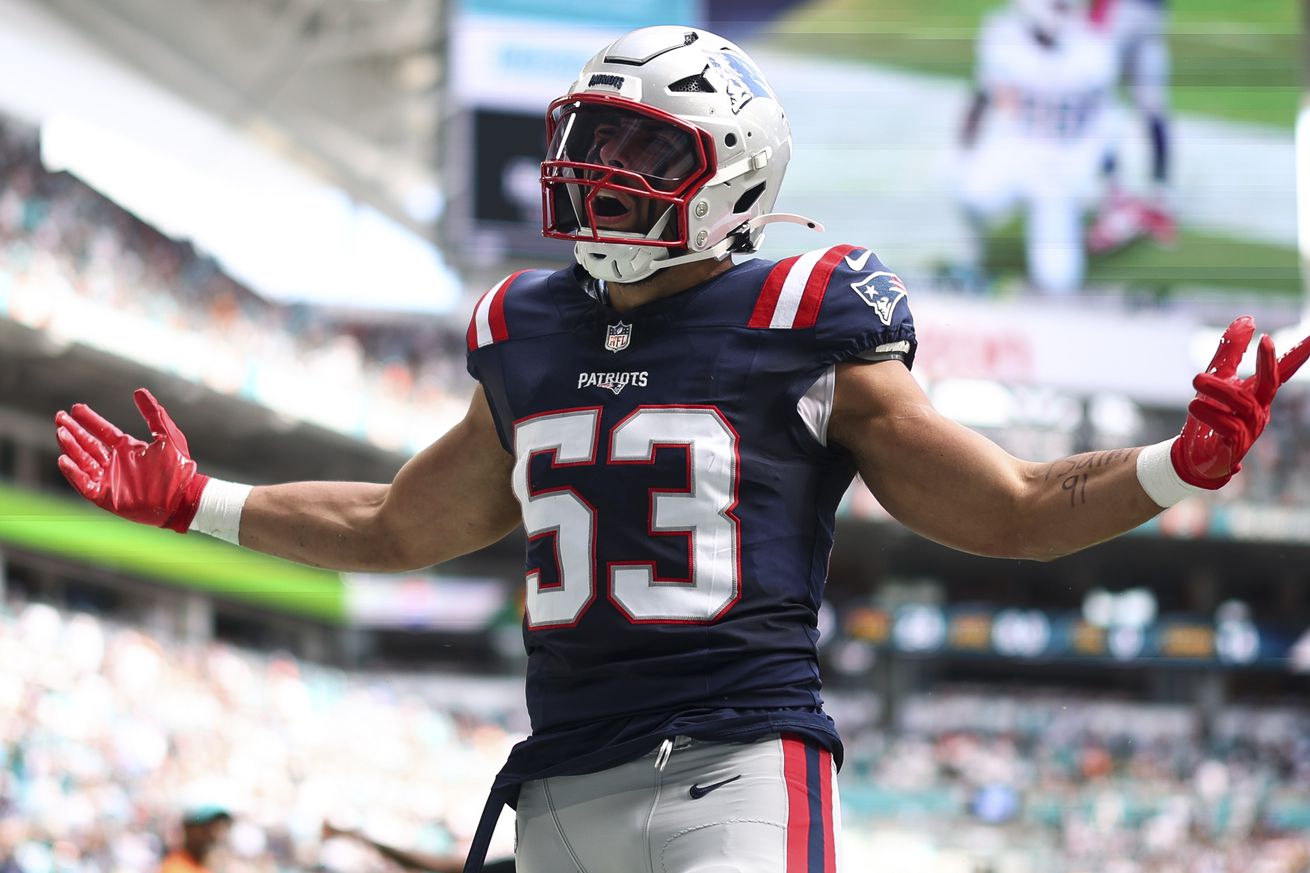
The Patriots will tender only one of their restricted free agents.
The New England Patriots entered the offseason with two of their players owning the restricted free agent designation. This gave the team an opportunity to tender them at one of three levels — first-, second- and original round/right of first refusal — in order to keep them from entering the open market on March 12.
The Patriots did so in one case, keeping linebacker Christian Elliss on the right of first refusal tender. Offensive lineman Lester Cotton, on the other hand, will not be tagged before the start of free agency.
Let’s assess wha the two decisions mean.
LB Christian Elliss: Tendered
Unsurprising move Pt. 1: Elliss ranked fourth on our list of the Patriots’ most important free agents this offseason, and for good reason. He showed promise as an off-ball linebacker with upside in the passing game, and also offers value as an experienced kicking game performer. While he does have room for grow particularly on defense, New England keeping him around was always the expected outcome.
Stability at linebacker: With Elliss going nowhere, the Patriots’ top three linebackers from a season ago will be back in 2025. In total, the team now has six players at the position under contract for the upcoming season as a look at our up-to-date roster shows:
Linebacker (6): Ja’Whaun Bentley (8), Jahlani Tavai (48), Christian Elliss (53), Curtis Jacobs (52), Monty Rice (45), Andrew Parker Jr. (47)
While personnel stability is a positive on the defensive side of the ball, there are questions about the state of New England’s linebacker group as a whole. Ja’Whaun Bentley missed most of the 2024 season due to a pectoral injury, Jahlani Tavai struggled in an extended role, Elliss had his ups and downs, while the other three — Curtis Jacobs, Monty Rice, Andrew Parker Jr. — are relative unknowns at the moment.
Cap impact: Elliss’ RFA tender essentially is a one-year deal that comes with a non-guaranteed $3.263 million salary that also functions as his cap number. Adding his contract to the Patriots’ Top 51 list therefore results in a net salary cap loss of $2.303 million: Elliss pushed a player with a $960,000 cap hit from the 51st to the 52nd spot on the payroll.
The nature of the contract in relation to a lack of guarantees means two things: 1.) Releasing him would come with no ramifications in the form of a dead cap, and 2.) The tender might end up as a placeholder in case New England wants to sign him to an extension to bring his current cap hit down.
OL Lester Cotton: Not tendered
Unsurprising move Pt. 2: Whereas Elliss ranked No. 4 on the list of most important free agents, Cotton found himself on the bottom of our list. It is also not hard to see why: his contributions after joining the team in late November were quite limited, and tendering him even at the right of first refusal level did not make fiscal sense considering the associated price tag of $3.263 million.
Needless to say, the expectation was that the Patriots would ultimately decide against such a move. While that does not rule out Cotton returning on a lower contract, his outlook is unclear at the moment.
Marginal roster implications: Cotton had virtually no impact for the Patriots after his arrival — such is the nature of being a backup offensive lineman. He saw action in three games but played only 19 combined offensive snaps.
As a result, him entering the open market and potentially leaving New England is no major blow to the team and its offensive line depth.